
Governor Carlos Camacho
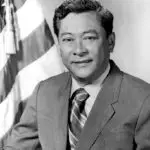
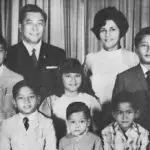
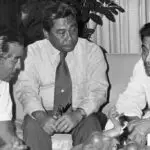
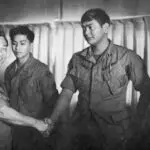
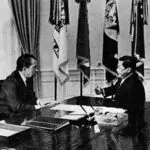
Table of Contents
Share This
Governor of Guam 1969-1974
Governor Carlos G. Camacho (1924 – 1979) served as not only Guam’s last appointed governor, but also its first elected governor after the Guam Elected Governor Act was passed in 1968. Camacho’s election in 1970 was the first time the people of Guam selected their own leader since the Spanish colonized the island beginning in 1668.
Camacho’s son, Felix Perez Camacho, was also elected governor of Guam in 2002 and 2006.
Early life
Camacho was born 16 November 1924, the middle of five children of Felix Martinez Camacho and Antonia Cruz Garcia. His siblings are Josephine Camacho Tanaka, John Camacho, Luis Camacho and Eddie Camacho.
They grew up in the Santa Cruz District in the heart of Hagåtña, helping in the family business by selling their daily catches of fish, door to door. The weekends were spent on the family farm where Guam Premier Outlets (GPO) is now, caring for the hogs and chickens and gathering coconuts for copra.
Carlos Camacho was educated at the Guam Institute and the Guam Evening High School until the Japanese invasion of Guam in 1941, when he was in the ninth grade. He was able to resume his education after the war. At the age of 16, Camacho worked after school as a clerk for Sawada Store and then later was a clerk at the Provisional Military Government and the Naval Government of Guam in the Department of Records and Accounts.
Though he did not graduate from high school, at the age of 18 Camacho took and passed a college entrance examination and left Guam in 1946 to pursue his college degree at St. Thomas Aquinas College in Grand Rapids, Michigan. He then earned a doctorate in dental surgery at Marquette University in Wisconsin, graduating in 1954 and returning to Guam to begin his dentistry practice. Camacho is remembered by many who knew him not only as the former governor, but as a dentist.
Camacho married the former Lourdes Duenas Perez in 1955. They had seven children: Carlos, Felix, Thomas, Mary, Ricardo, Francis, and Victor.
Career
Camacho worked as a dentist at the Catholic Medical Center, which opened in 1955, and also served as a captain in the US Army Dental Corps for two years. He was drafted in the dental corps, and was assigned to Camp Zama, Japan. He was promoted to the rank of captain and returned home after two years and reopened his dental practice.
He entered politics in 1964, running as a senatorial candidate for the Territorial Party (predecessor of the Republican Party) of Guam and winning a seat in I Mina’ Ocho na Liheslaturan Guåhan/the 8th Guam Legislature. He served as chairman of the legislative Public Health and Welfare Committee and was a member of four other committees.
In 1966 no candidates of the Territorial Party were elected into the Legislature. Camacho, along with Territorial Party colleagues, including Joseph Flores and Kurt Moylan, founded the Republican Party of Guam. Camacho served as chairman for the party’s Guam delegation to the National Republican Convention in Miami in 1968, where he met many high-ranking US political leaders, including then-President Richard M. Nixon. The following year Nixon appointed Camacho to the position of governor on 1 July 1969.
Governor of Guam
At the young age of 44, Camacho succeeded Governor Manuel FL Guerrero as governor of Guam, with Kurt Moylan appointed as lieutenant governor.
Camacho’s term as appointed governor lasted only 18 months, due to the Elective Governor Act that was signed into law by the US Congress in 1968, allowing for Guam’s citizens to choose their governor. The act took effect in 1970, when Guam’s first election was held.
Camacho’s term was best remembered for his Christmas 1969 visit to the troops from Guam who were fighting in Vietnam. He brought with him celebrated local singer Johnny Sablan who wrote a song about the feat:
More and more fighting sons have died. Peace, freedom, courage and pride. Forever they will roam in the eyes of the people here at home, in the eyes here at home. In memoriam I sing to you, I bow my head and salute you too. My native brothers you died in Vietnam, but heroes you are here on Guam, the fighting sons of Guam.
He went to Vietnam so to seek his fighting sons. To wish them well, the soldiers of Guam. Called out their names all over Vietnam, saying ‘I want to see my sons of Guam. I want to see my fighting sons of Guam.’
He said ‘Hafa adai, my sons, how do you do? My name? They call me Governor Camacho. I came to see you, brought a message for you, from the people of Guam, your island in the sun.’
He flew from Saigon up to Pleiku, just to wish his sons there Merry Christmas, too. Danang, Nha Trang, Long Binh and Bien Hoa, too. Hafa adai, Cam Ranh Bay, Merry Christmas to you. Well my sons, you’re not forgotten, this I’m glad to say. I brought you a gift from home. Your families and your dear friends, I bring to you. They would like wish you a Merry Christmas too. Merry Christmas my sons.
They choked up and cried, they held their heads up with pride, as they gazed at their presents side by side. One young soldier said, ‘Mr. Governor, thank you lai! You’ve made my Christmas so great, you’ve made my Christmas so great.’
Four hundred or more soldiers he met. Jesus, Mike, Joaquin, Chu, Alfred, Antonio, Jose, Manuel and Norbert, too. Shaking hands, saying ‘Merry Christmas to you, Merry Christmas my sons.’
There’s Jerry and Ron, Billy and Juan. There goes Joseph, Jesse, William and Big John. Albert, Felix, Tony and Benny too. They all said, ‘Thank you, Governor Camacho, thank you, Governor Camacho.’
He’s a man of distinction, a man with a mission. No intervention to stop his intention. He’s a soldier of Guam. He’s a soldier of Guam.
Camacho was welcomed enthusiastically by the Guam troops who held parties in his honor. The success of this visit boosted Camacho’s popularity on Guam, which helped him tremendously in the historic 1970 election.
Camacho at first selected prominent politician Senator G. Ricardo Salas as his running mate, but disagreements with Salas led him to choose Kurt Moylan instead. The two ran unopposed in the Republican primary, while the Democratic primary was closely contested between former Governor Manuel FL Guerrero, Senator Ricardo J. Bordallo, and attorney and former Speaker Joaquin Camacho Arriola. After a close primary and a contentious runoff election in which Bordallo defeated Guerrero, and then Camacho defeated Bordallo in the general election by 11.6 percent of the 20,424 votes cast.
Camacho and Moylan’s historic inauguration was held 3 January 1971 at the Plaza de España in Hagåtña.
Camacho’s term as elected governor was marked by one of Guam’s greatest economic booms. He used the resources of the government to enhance economic opportunities by granting incentives through the Guam Economic Development Authority and offering various forms of assistance to the private sector. During his entire five and a half years in office, Camacho presided over one of the largest eras of hotel construction activities on Guam, with construction finishing or starting on the Kakue Hotel, Reef Hotel, Hilton Hotel, Okura Hotel, Fujita Tumon Beach, Continental Travelodge, and Guam Dai Ichi Hotel.
Camacho also initiated massive road projects that were continued by his successors, including the widening of Marine Drive (now Marine Corps Drive) from Hospital Road north to Route 16 in Harmon, and the reconstruction of other major highways in the villages of Hågat, Dededo and Tamuning, among others.
He is also credited with enticing many educated CHamorus/Chamorros back to Guam, to reverse what was seen as a “brain drain” at the time, including Tony Palomo, Greg Sanchez, Mary Sanchez, Tony Unpingco, Dr. Pedro Sanchez, Dr. Katherine Aguon, Juan C. Tenorio, Bert Unpingco, Ben Perez, Eddie Duenas, Joseph F. Ada and Frank Blas. Many of them took jobs with the government of Guam as administrators and later became senators. Camacho also kept on other able administrators even if they were not of his party affiliation which served to stabilize the government.
Former Senator Joe T. San Agustin considers this Camacho’s greatest accomplishment:
Many of today’s leadership in government and business would not be here today if the brain drain syndrome had not been reversed. And coincidentally, this reversal was not limited to government only, as the 1970s also saw our local people assuming leadership heights in other areas. The Federal Court in Guam received its first Chamorro federal judge in Judge Cristobal C. Duenas, and the 300-year old Catholic Church in Guam saw its very first native bishop, Bishop Felixberto C. Flores. Duenas and Flores, along with Camacho, formed a great triumvirate. And a twist in history – all three were first cousins: Cristobal Camacho Duenas, Felixberto Camacho Flores and Carlos Garcia Camacho.
As a team, Camacho and Moylan worked to develop economic opportunity by creating incentives to attract business and encourage local participation in business. At the time Guam elected its first governor the federal government still had control over much of the island’s utilities and roads. They struggled to work toward gaining more self government and self determination.
In 1974 Camacho ran for re-election but lost to Democrat Ricardo J. Bordallo in a runoff election, after the general election, by just 627 votes. Following his defeat, Camacho returned to his career as a dentist, continuing in private practice until his death on 6 December 1979.
By Leo Babauta and Shannon J. Murphy
For further reading
I Manfåyi: Who’s Who in Chamorro History. Vol. 1. The Hale’-ta Series. Hagåtña: Political Status Education and Coordinating Commission, 1995.
Rogers, Robert. Destiny’s Landfall: A History of Guam. Honolulu: University of Hawai’i Press, 1995.
Sanchez, Pedro C. Guahan Guam: The History of Our Island. Hagåtña: Sanchez Publishing House, 1987.